Ubox
Online booking for a private mini-theatre and celebration venue: hall browsing, time slots, add-ons and online checkout, backed by a NestJS API and a staff dashboard - later simplified and handed over cleanly.
Case study by Balaji Sankar · Updated October 2026
Focused build of the booking site and staff dashboard
Clean handover to an incoming team with documentation and a prioritised backlog
Why did it need to exist?
- Bookings handled by phone and chat
- Pricing that changes with guest count
- Six different slot behaviours
- Venue rules scattered and hard to change
- An online booking site with live totals
- Capacity-aware pricing set in a venue wizard
- One booking card for every slot type
- A staff dashboard built on guided venue setup
What made it hard?
A private screening venue hosting birthdays, anniversaries, proposals and small celebrations was taking every booking by phone and chat.
They wanted customers to browse halls, pick a slot, add decorations and extras and book online, with staff managing venues, pricing, bookings and payments from one dashboard.
How did I approach it?
A fast booking site
A single-page marketing and booking site with hall listings, a detailed booking card handling several slot types, capacity-aware pricing, occasions and add-ons, and separate desktop and mobile layouts.
Payments end to end
The first version took full bookings: live venue and slot data from the API, PhonePe checkout, and proper success and failure handling.
A dashboard for the front desk
I set up the admin dashboard and built venue management, the booking create flow, OTP login, the payment page and booking details, with my team building the NestJS API and the remaining admin screens.
Simplify, then hand over properly
When the business chose to manage availability by hand, the site moved to a lead-capture flow feeding the venue’s task board and calendar. I stripped the unused payment stack and dead dependencies and wrote a full handover guide with a prioritised backlog.
Which calls shaped it?
One booking card for every rule
Fixed, hourly, package, combo, time-range and dual-purpose slots all behave differently, plus occasions, add-ons and capacity pricing.
I built a single booking component that handles every slot behaviour, with separate desktop and mobile layouts.
- Simple booking on any device
- Rules handled in one place
Capture pricing once, in a wizard
Pricing rules scattered across screens would drift and confuse staff.
Venues are set up through a guided wizard: amenities, intervals, capacity pricing, occasions, add-ons, date overrides and payment policies.
- Pricing reused everywhere
- Fewer configuration mistakes
Simplify rather than abandon
Later the business chose a lighter way of taking bookings.
I moved the site to an enquiry flow into Trello and the venue calendar, removed the payment stack and unused dependencies, and wrote handover docs.
- A smaller, cleaner codebase
- README, architecture notes and backlog for the next team
What did I build?
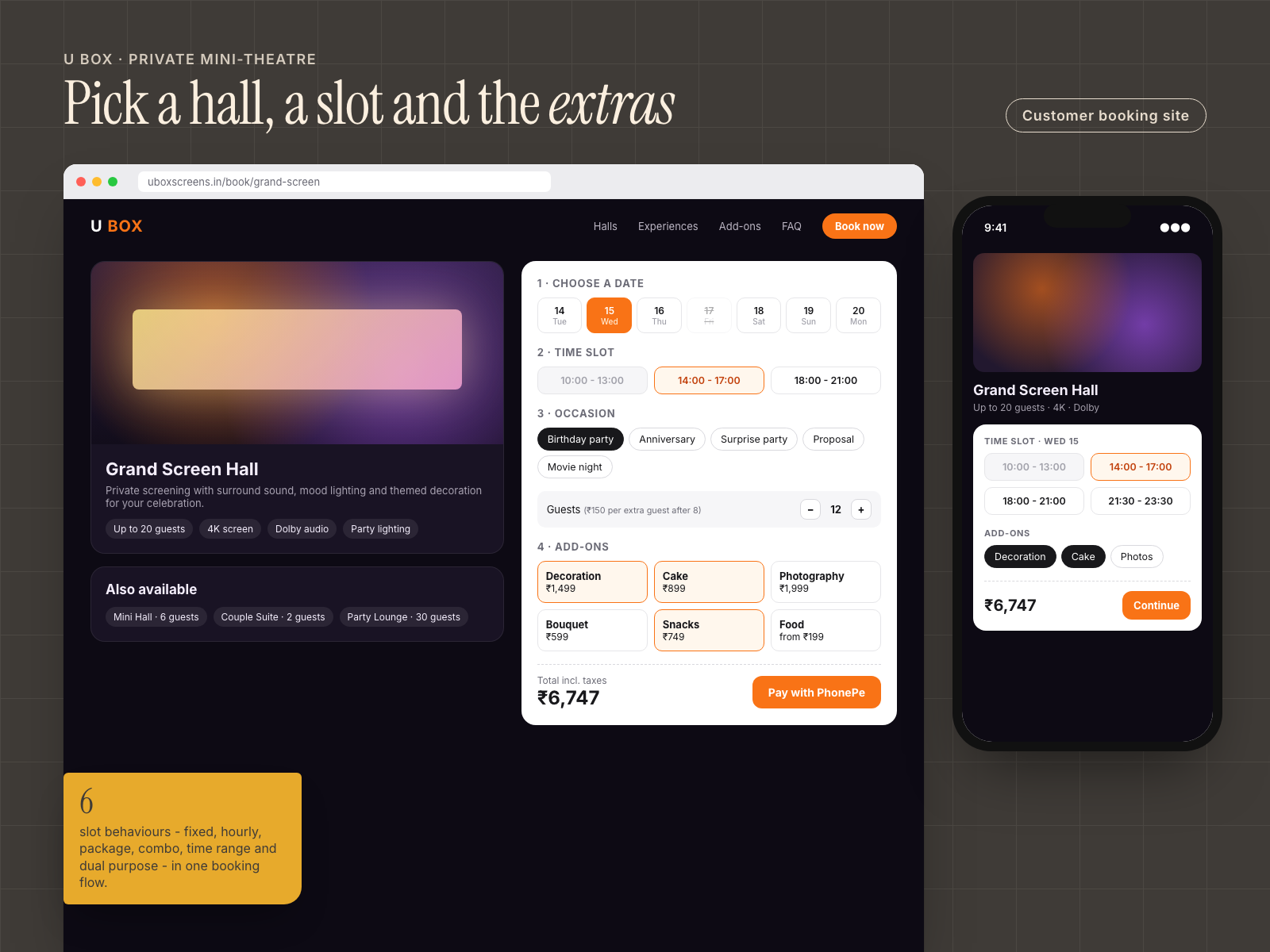
- (01)
One booking flow covering multiple slot behaviours, add-on pricing and validation on desktop and mobile.
- (02)
Booking site and staff dashboard built in roughly two weeks of focused work, on an API the team started a week earlier.
- (03)
A backend covering venues, pricing and booking rules, discounts, invoices, front desk, WhatsApp notifications and OTP login.
- (04)
A handover a new team could pick up on day one: accounts checklist, environment reference, architecture notes and the old payment system preserved for reuse.
What is it built on?
Hide complexity from customers
Rules live in the system, not in the customer’s head.
Configure once
A guided setup keeps every screen consistent.
Handover is part of the product
Clean code and documentation are deliverables.
How was it delivered?
- Late Nov 2025
API foundations
NestJS auth and venue management modules, with OTP via AWS SNS.
- Dec 2025, week 1
Booking experience and API
Booking UI on the hall-list API and PhonePe setup; API modules for listing, booking, customers, discounts, front desk, PhonePe and WhatsApp.
- Dec 2025, week 2
Payments and dashboard
Payment success and failure handling, booking confirmation, and the dashboard booking flow, payment page and booking view.
- Mid Dec 2025
Enquiry flow
Static venue cards with booking and contact enquiries sent to Trello and the venue calendar.
- July 2026
Clean-up and handover
Disabled payment stack and 34 orphaned dependencies removed, plus README, handover guide and backlog.
What did I learn?
Rules deserve one home
A single booking component made a complex pricing model feel simple.
Business models change
Building cleanly made it easy to simplify when the venue changed course.
Documentation saves weeks
Handover notes let the next team start without reverse-engineering.
Questions about this project
- What did Balaji Sankar build in the Ubox project?
- Online booking for a private mini-theatre and celebration venue: hall browsing, time slots, add-ons and online checkout, backed by a NestJS API and a staff dashboard - later simplified and handed over cleanly.
- Who was the client?
- Ubox, in hospitality / venue booking.
- What was the hardest part?
- A private screening venue hosting birthdays, anniversaries, proposals and small celebrations was taking every booking by phone and chat.
- What was his role?
- Technical lead; built the booking site and core booking flows.
- What technology was used?
- React 19, TypeScript, Vite, TanStack Router, Tailwind CSS v4, shadcn/ui, Framer Motion, NestJS, TypeORM, PhonePe and Netlify.
- What were the results?
- ~2 weeks focused build of the booking site and staff dashboard and Clean handover to an incoming team with documentation and a prioritised backlog.
Have a project like this?
Tell me what you’re building or what’s broken. I’ll tell you straight whether I’m the right person for it.