Vehicle DealerHub
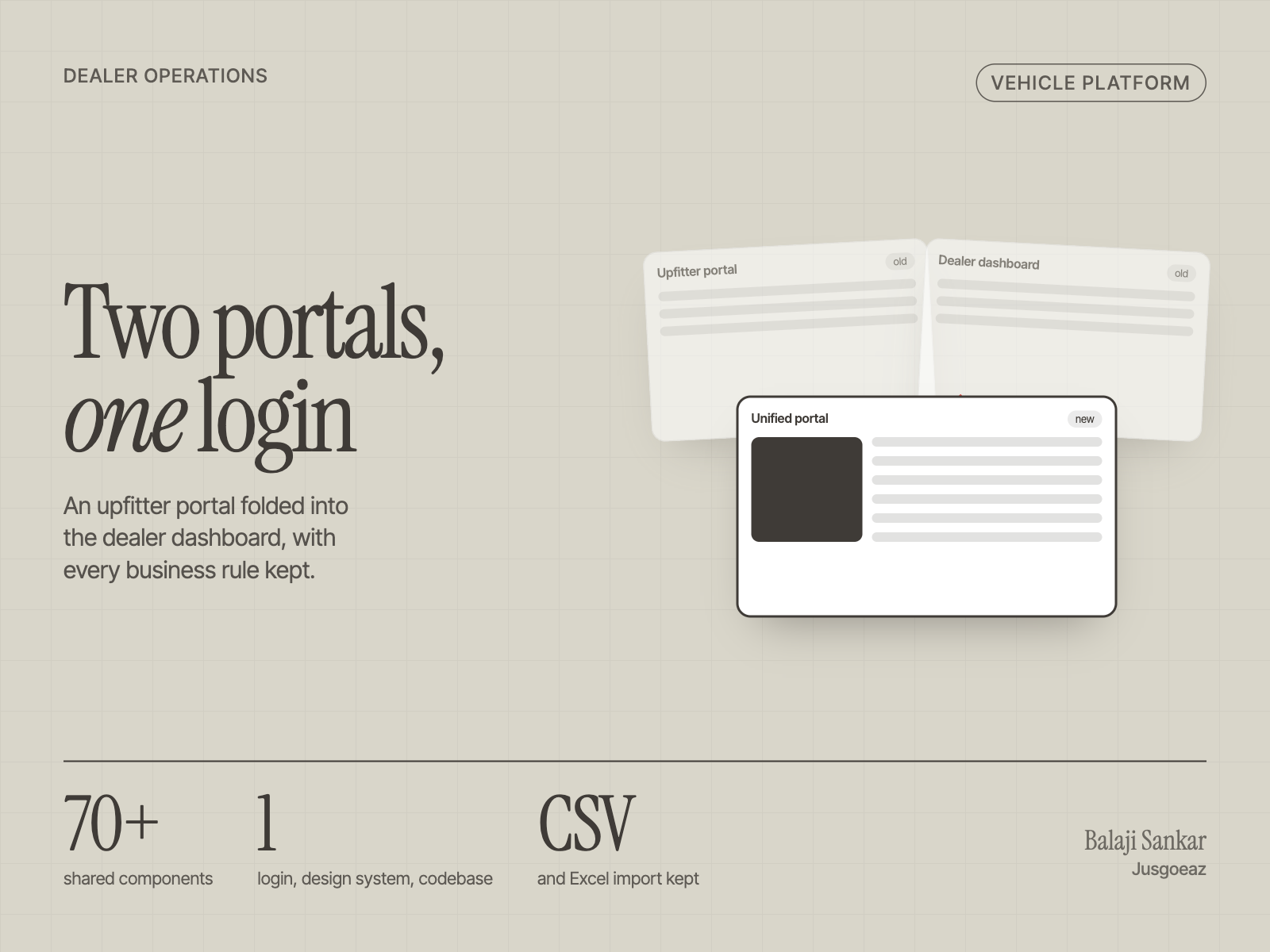
I merged a standalone upfitter portal into the main dealer dashboard of a vehicle platform: one login, one design system and one codebase, with no business logic lost.
Case study by Balaji Sankar · Updated October 2026
Shared components reused instead of rebuilt
Upfitter workflows moved into the dealer dashboard: one codebase, one login and one design system
Why did it need to exist?
- Dealers and upfitters on two separate frontends
- Two design systems, routers, state layers and logins
- Related order workflows that looked and behaved differently
- Business rules that could not be dropped
- One unified dashboard for dealers and upfitters
- One login through Keycloak SSO
- Upfitter screens built from the existing component library
- A full specification before any code was written
What made it hard?
Getting work vehicles into a fleet involves the buyer, the dealer that sells the chassis and the upfitter that turns it into a working truck or van. The platform had separate web apps for these groups.
The upfitter portal ran as its own deployment with its own design system, state layer, router and login, so upfitters and dealers got different experiences and the team was maintaining two frontends for closely related order workflows.
How did I approach it?
Spec first
I read the legacy portal end to end and wrote a migration requirements doc covering every screen, business rule and edge case, mapping each legacy component to its dealer-dashboard equivalent before writing any code.
Re-platform, don’t copy
MUI Joy became shadcn/ui and Tailwind on the dashboard’s tokens, Redux and RTK Query became React Query with scoped context, React Router became file-based TanStack Router, Yup became Zod and moment became date-fns.
Reuse what exists
Upfitter screens were built from the dashboard’s existing order-tracking components and page layout, so they look and behave like the rest of the product.
Build in phases
The core migration was delivered in seven phases, with analytics kept continuous throughout.
Which calls shaped it?
Write the specification first
Almost every layer was changing at once, which made it easy to lose a business rule.
I read the legacy portal end to end and wrote a migration requirements document mapping every screen, rule and edge case.
- Every rule tracked before coding
- Legacy components mapped to dashboard equivalents
- A clear plan for phased delivery
Re-platform rather than copy
Copying the old code would have kept a second design system and state layer alive inside the dashboard.
MUI Joy became shadcn/ui and Tailwind, Redux and RTK Query became React Query, React Router became TanStack Router, Yup became Zod and moment became date-fns.
- One stack across the product
- No parallel UI kit to maintain
- 70+ existing components reused
Retire magic-link login
Migrating the portal's own auth pages would have duplicated login flows.
Upfitters moved onto the dashboard's Keycloak SSO, so the auth pages did not need migrating at all.
- One login for both groups
- Less code moved
- Datadog, Amplitude and PostHog kept in place
What did I build?
- (01)
Open and completed order workflows, bulk CSV and Excel import, filtering, search, export and upfitter profile management moved into the unified dashboard.
- (02)
Magic-link login retired in favour of the dashboard’s Keycloak SSO, so auth pages didn’t need migrating at all.
- (03)
New screens built from a 70+ component internal library rather than a parallel UI kit.
- (04)
Datadog kept alongside Amplitude and PostHog so monitoring history survived the cutover.
What is it built on?
Reuse before building
Use the existing component library rather than creating parallel UI.
Keep every rule
No business logic is dropped just because the stack changes.
Keep monitoring continuous
Analytics and monitoring survive the cutover.
How was it delivered?
- Phase 1
Legacy review and spec
End-to-end read of the upfitter portal and a requirements document for every screen and rule.
- Phase 2
Component mapping
Mapped each legacy component to the dashboard's existing component library and page layouts.
- Phase 3
Phased migration
Upfitter workflows rebuilt inside the dashboard over seven implementation phases.
- Next
Hardening and retirement
Tests, lazy loading, CI/CD updates and retirement of the old portal, planned as the final phases.
What did I learn?
Specs make big moves safe
Writing every rule down first made a many-layer change manageable.
Delete what you can
Retiring the old login removed a whole set of screens from the migration.
Libraries pay off twice
A strong existing component library made the upfitter screens fast to build and consistent.
Questions about this project
- What did Balaji Sankar build in the Vehicle Dealer Hub project?
- I merged a standalone upfitter portal into the main dealer dashboard of a vehicle platform: one login, one design system and one codebase, with no business logic lost.
- Who was the client?
- A vehicle platform for fleets, dealers and upfitters, in vehicle platform / dealer operations. The work is under NDA, so the client is not named.
- What was the hardest part?
- Getting work vehicles into a fleet involves the buyer, the dealer that sells the chassis and the upfitter that turns it into a working truck or van. The platform had separate web apps for these groups.
- What was his role?
- Frontend engineer - specification and implementation.
- What technology was used?
- React, TypeScript, Vite, TanStack Router, TanStack Query, shadcn/ui, Tailwind CSS, Zod, date-fns and Keycloak.
- What were the results?
- 70+ shared components reused instead of rebuilt and Upfitter workflows moved into the dealer dashboard: one codebase, one login and one design system.
Have a project like this?
Tell me what you’re building or what’s broken. I’ll tell you straight whether I’m the right person for it.