Scabbr
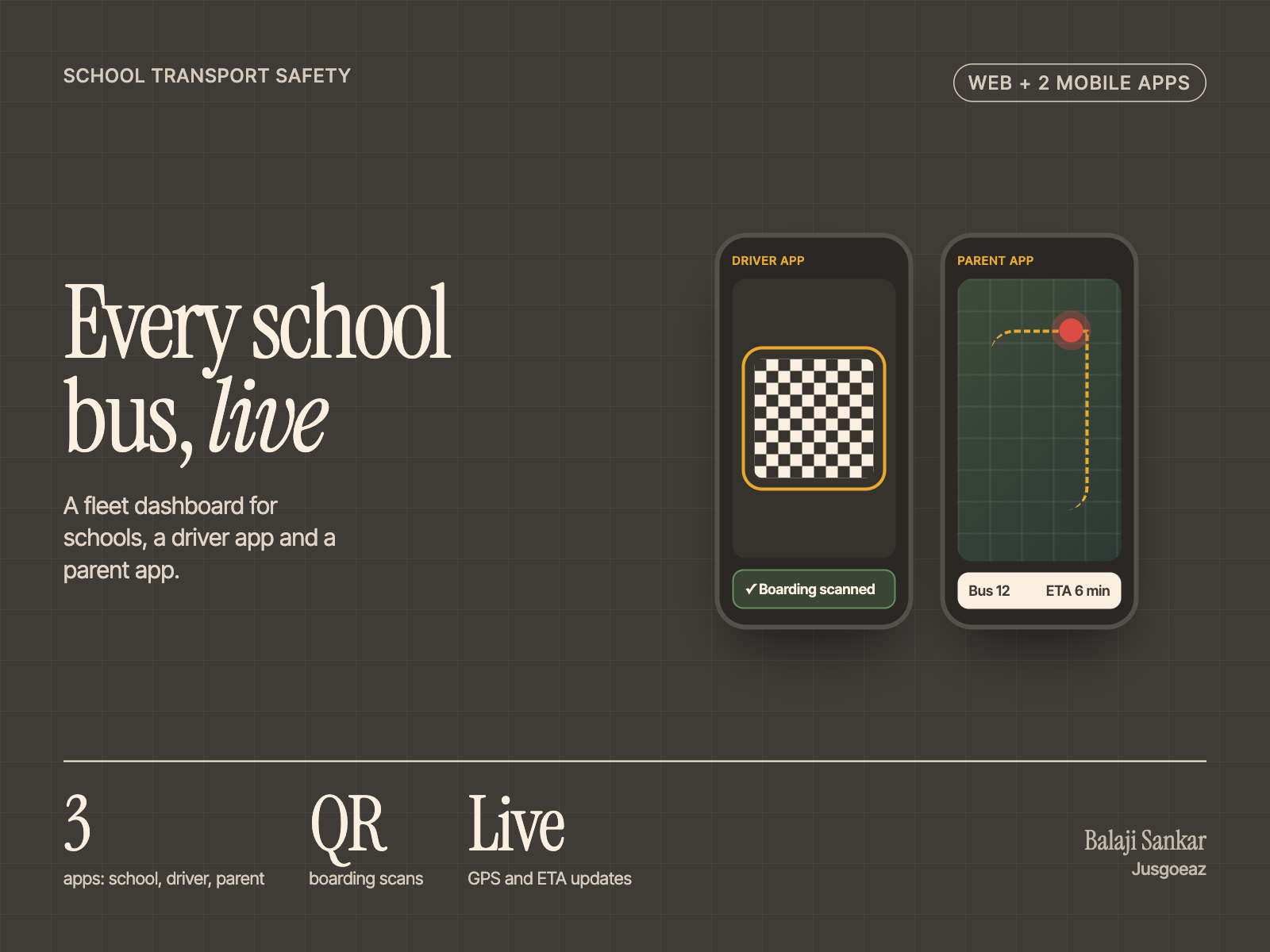
Live school-bus tracking, end to end. I led every client surface of a three-sided product: a fleet dashboard for schools, a driver app that streams GPS and scans children on board, and a parent app that shows exactly when the bus will arrive.
Case study by Balaji Sankar · Updated October 2026
Surfaces shipped - school dashboard, driver app and parent app
Bus position refresh in the parent app
ETA refresh cycle driven by the driver’s phone
Why did it need to exist?
- Parents had no idea where the school bus was
- Schools had no single view of their fleet
- No verified record of which child boarded
- Admin work had to suit non-technical school staff
- A parent app with the live bus and an ETA
- A school dashboard with every bus on one map
- QR boarding scans for each child
- Bulk import and map-based stop placement
What made it hard?
Parents had no idea where the school bus was, and schools had no single view of their fleet, their routes or which children were actually on board.
The client wanted one product covering everyone in that chain: the school admin planning routes, the driver running the trip and the parent waiting at the stop - all talking to the same GraphQL API.
How did I approach it?
A multi-tenant console
A super admin onboards schools; school admins run their own fleet, with modules for buses, drivers, students, stops, routes, trips, roles and subscriptions, plus a bird’s-eye map of every vehicle.
Admin UX for non-technical staff
Spreadsheet import with validation, per-student QR codes, in-browser photo cropping, and stop planning by Places search or click-to-drop markers on a map.
A driver app that does the work
OTP login, start and end trip, live GPS broadcast with proper permission handling, and QR scanning to mark each child on and off the bus.
A parent app that answers one question
Where is the bus and when will it reach my stop - a live map, an ETA and the child’s pickup point.
Which calls shaped it?
One API for three surfaces
Schools, drivers and parents each needed a different app, but all had to reflect the same trip.
The web console, driver app and parent app all use the same GraphQL API, so a trip is one record seen from three angles.
- Consistent trip data everywhere
- One trip record behind all three apps
- New modules reuse the same API
Verified attendance with QR codes
A bus location alone does not tell a school which children are on board.
Each student gets a QR code that the driver scans at boarding.
- A verified boarding record
- Clear data for schools and parents
- No extra hardware beyond the driver's phone
Tuned update intervals
Parents want a live bus, but constant GPS work drains driver phones and data.
The driver app sends a position update every 50 metres of movement and refreshes the ETA every 30 seconds; the parent app polls the bus position every two seconds.
- Near real-time map for parents
- Regular ETA updates
- Fewer location updates from a parked or slow bus
What did I build?
- (01)
One frontend owner across a web console and two React Native apps.
- (02)
Driver app sends its position every 30 seconds so the server can refresh the ETA to the next stop.
- (03)
Parent app refreshes the bus position every two seconds.
- (04)
QR-based boarding gives schools a verified record of which child got on and off where, not just where the bus was.
- (05)
Later grew into a lighter school ERP: timetable, library lending, leave, staff, a calendar and a notice board with real-time messaging over GraphQL subscriptions.
What is it built on?
One trip, three views
Everyone sees the same trip from their own angle.
Simple for non-technical staff
School office work should be hard to get wrong.
Safety means verification
Record who boarded, not just where the bus is.
How was it delivered?
- Phase 1
School dashboard
Multi-tenant console with a super admin and school admins, buses, drivers, stops and routes, with stop placement by Places search or map click.
- Phase 2
Driver and parent apps
Both React Native apps built in parallel: OTP login, trips, live GPS and QR boarding scans for drivers, and a live bus map with an ETA for parents.
- Phase 3
Fleet view and admin at scale
A bird's-eye fleet map, bulk student import, per-student QR codes, photo cropping and edit limits.
- Phase 4
School-management add-ons
Staff, timetable, calendar, library lending, leave management and a real-time notice board, built with my studio team, that took the platform beyond transport.
What did I learn?
Shared APIs keep apps in sync
One GraphQL API made three very different apps agree on every trip.
Design for the least technical user
Bulk import, QR generation and map-based stop placement were built for school office staff, not engineers.
Platforms grow
Once the core data was in place, a tracking tool grew into wider school management.
Questions about this project
- What did Balaji Sankar build in the Scabbr project?
- Live school-bus tracking, end to end. I led every client surface of a three-sided product: a fleet dashboard for schools, a driver app that streams GPS and scans children on board, and a parent app that shows exactly when the bus will arrive.
- Who was the client?
- Scabbr, in edTech / student transport safety.
- What was the hardest part?
- Parents had no idea where the school bus was, and schools had no single view of their fleet, their routes or which children were actually on board.
- What was his role?
- Frontend owner across web and mobile.
- What technology was used?
- React, Apollo Client, GraphQL, Redux, Ant Design, Tailwind, Google Maps, React Native, Redux-Saga and react-native-maps.
- What were the results?
- 3 surfaces shipped - school dashboard, driver app and parent app, 2s bus position refresh in the parent app and 30s ETA refresh cycle driven by the driver’s phone.
Have a project like this?
Tell me what you’re building or what’s broken. I’ll tell you straight whether I’m the right person for it.