Industrial SalesCRM
A custom sales CRM built around how an industrial manufacturer really sells: pipeline, targets, ERP-backed billing and leadership-grade funnel reports for a field sales force spread across India.
Case study by Balaji Sankar · Updated October 2026
Built from January 2020 to August 2021 and deployed to the client’s own domain, with maintenance into 2022
Targets measured against ERP billing, orders and collections instead of self-reported numbers
Why did it need to exist?
- Opportunities kept in spreadsheets and inboxes
- Managers blind to pipeline across their teams
- Off-the-shelf CRMs ignored the real org chart
- Targets based on self-reported numbers
- One pipeline following the client's six sales stages
- Role-based access over zones, offices and divisions
- Org structure and fiscal year as configuration
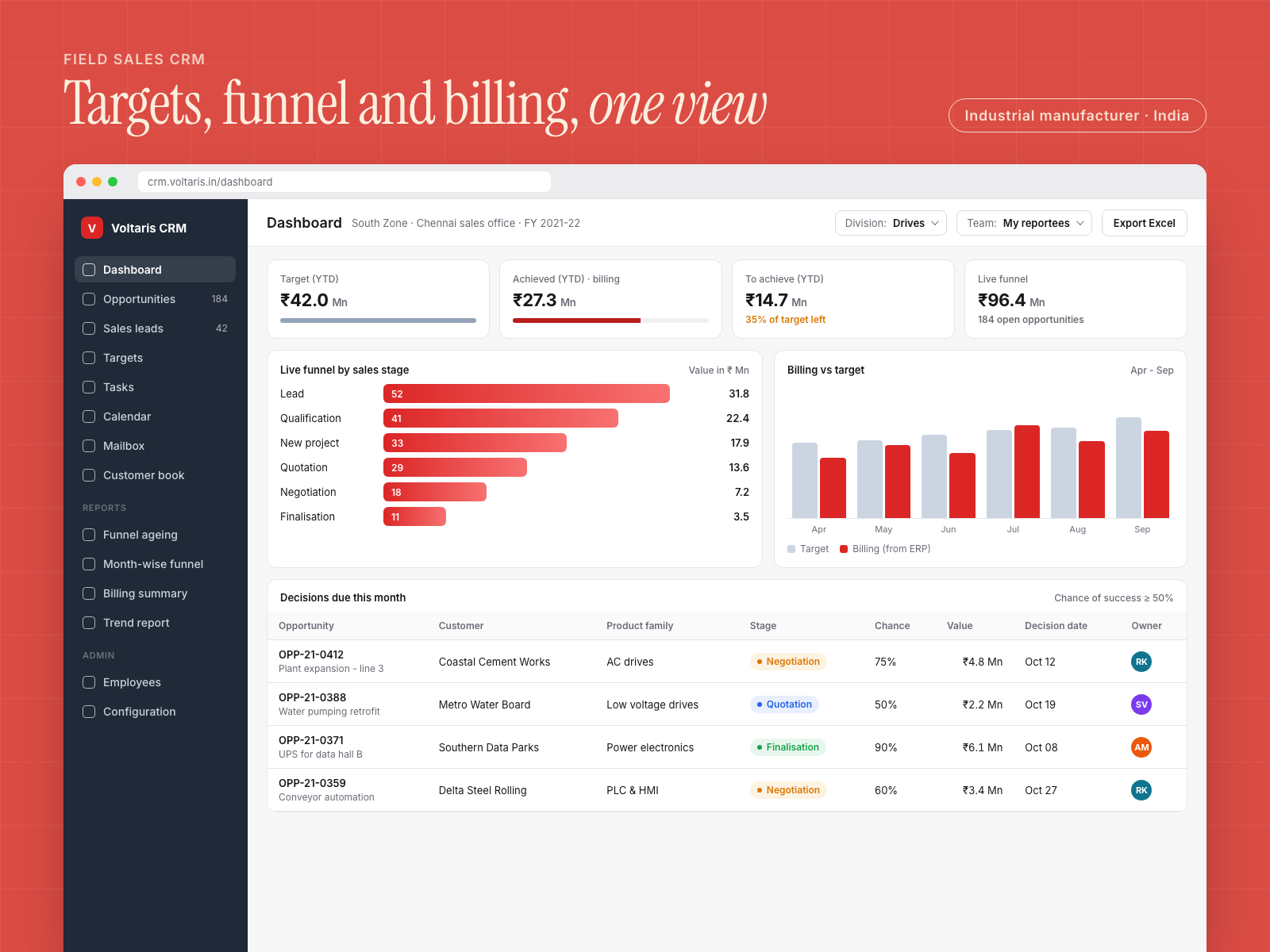
- Targets measured against imported ERP numbers
What made it hard?
The client sells high-value industrial equipment through a large field team spread across zones, sales offices, divisions and channels. Opportunities lived in spreadsheets and inboxes, managers couldn’t see pipeline health across their reporting tree, and leadership had no reliable funnel or forecast.
Off-the-shelf CRMs didn’t model their org structure, fiscal year, product hierarchy or the way they track competitors on every deal.
How did I approach it?
Model the real org chart
Role-based access over the actual reporting hierarchy - zones, offices, divisions, channels and segments - so each person sees their own work and managers see their team’s.
A pipeline that matches their sales stages
Opportunities move from lead through qualification, quotation, negotiation and finalisation, with products from a multi-level catalogue, pricing, decision dates, competitor tracking and win/loss reasons.
Measure against real numbers
Targets by period and fiscal year, tracked against billing, orders and collections imported from the client’s ERP rather than self-reported figures.
Reports leadership actually uses
Funnel ageing, month-wise funnel, conversion history, billing summaries and trend reports, with full Excel exports.
Which calls shaped it?
Model the organisation first
Every list and report depends on who reports to whom, and generic CRMs could not express the client's structure.
Zones, sales offices, divisions, channels, segments, roles and the fiscal year became configuration that drives access and reporting.
- Managers see their own reporting tree
- Structure changes without code changes
- Reports reflect the real hierarchy
Targets against ERP numbers
Targets only work when people cannot argue with the numbers they are measured against.
My studio teammate built the ERP import jobs for billing, orders and collections, and I surfaced the numbers on the dashboard and in reports with Excel export.
- Targets tracked against real billing
- Booking and billing targets on the dashboard
- Collections visible next to bookings
Keep departing reps' deals
When someone left, their open opportunities could vanish from view.
Inactive employees' opportunities stay visible and can be reassigned to active reps.
- No lost pipeline when people leave
- Clean reassignment
- History preserved
What did I build?
- (01)
Hierarchy, divisions, segments and role types drive what every screen shows.
- (02)
Paginated tables, configurable drag-and-drop columns and heavy Excel exports for sales data at enterprise volume.
- (03)
Lead bulk upload and lead-to-opportunity conversion, plus tasks, calendar, an in-app mailbox and a customer playbook.
- (04)
Inactive-employee handling so a departing rep’s deals stay visible and can be reassigned.
- (05)
Scheduled nudges for decision dates, manager digests and high-value or lost-deal alerts.
What is it built on?
Structure in configuration
The business can change its organisation without a code release.
Numbers people trust
Measure against the ERP, not self-reported figures.
Built for volume
Pagination, configurable columns and heavy exports keep large datasets usable.
How was it delivered?
- Phase 1
Organisation and pipeline
Configuration screens for the org structure, plus opportunity create, edit and clone across the six stages (Jan - Feb 2020).
- Phase 2
Reports, targets and nudges
Funnel ageing, targets, weekly chance-of-success digests, inactive-employee handling and decision-date alerts (Mar - Sep 2020).
- Phase 3
Billing data
Billing uploads, then ERP imports of billing, orders, pending orders and collections, with billing summary, month-wise funnel and conversion reports (Oct 2020 - Mar 2021).
- Phase 4
Archiving and maintenance
Inactive-opportunity and playbook archives and sync jobs (Aug 2021), then maintenance into 2022.
What did I learn?
Hierarchy is the foundation
Getting the org model right first made every report possible.
Real numbers motivate
Importing ERP billing turned targets from opinions into facts.
Plan for people leaving
Handling inactive employees protected pipeline history the business depended on.
Questions about this project
- What did Balaji Sankar build in the Industrial Sales CRM project?
- A custom sales CRM built around how an industrial manufacturer really sells: pipeline, targets, ERP-backed billing and leadership-grade funnel reports for a field sales force spread across India.
- Who was the client?
- The India arm of an industrial-electrical multinational, in industrial manufacturing / B2B sales. The work is under NDA, so the client is not named.
- What was the hardest part?
- The client sells high-value industrial equipment through a large field team spread across zones, sales offices, divisions and channels. Opportunities lived in spreadsheets and inboxes, managers couldn’t see pipeline health across their reporting tree, and leadership had no reliable funnel or forecast.
- What was his role?
- Technical lead and frontend owner.
- What technology was used?
- React, Apollo Client, GraphQL, Redux, Ant Design, ApexCharts, react-dnd, SheetJS, Node, GraphQL Yoga, Prisma and AWS S3.
- What were the results?
- Built from January 2020 to August 2021 and deployed to the client’s own domain, with maintenance into 2022 and Targets measured against ERP billing, orders and collections instead of self-reported numbers.
Have a project like this?
Tell me what you’re building or what’s broken. I’ll tell you straight whether I’m the right person for it.